
Balance Exercises for Fall Prevention: Building Strength and Confidence
By Dr. Sakshi Bhatia, Physiotherapist, Vyana Care
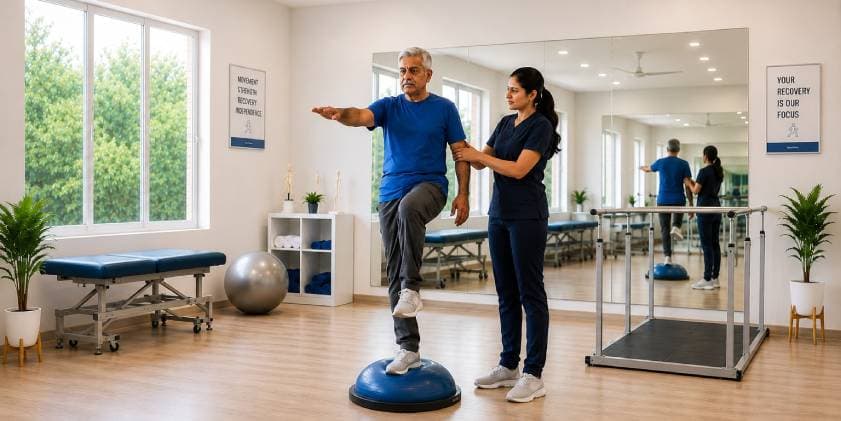
Off the couch. Bags out of the car. Something down from the top shelf. Tying a shoe. You do it all without thinking, your body just gets on with it while your head's somewhere else entirely.
Then at some point it isn't easy anymore, and you can't always say exactly when that started. It usually comes down to balance, strength, or trust in your own body, and honestly these three don't stay in their own lanes for long. Lose ground in one, the other two often go with it. Sometimes that happens over years. Sometimes it feels like it happened in a single bad week. That's the real reason balance exercises for fall prevention rarely show up on their own; strength work tends to ride along, and so, quietly, does rebuilding some confidence.
What Keeps You Steady on Your Feet?
Nothing single-handedly keeps you upright. It's a pile of small habits, the kind you never notice until one stops pulling its weight.
A few things worth paying attention to:
- You push off with both hands to get out of a chair, or bed
- Walking feels a bit wobbly, whether that's around the house or out and about
- Stairs. Curbs. Uneven ground. All of it needs more concentration than it used to
- Groceries or a laundry basket feel heavier than you remember
- You've quietly stopped going places or doing things, just in case
Most of the time none of this is anything to panic about. It's an ordinary dip, in balance, strength, confidence, take your pick, and it happens to be exactly the sort of thing physiotherapy is good at sorting out.
Why Has This Become So Common?
There's a popular story that staying steady with age is basically about grit. Push through it. Attitude does count for something, sure, but if the body underneath can't keep up, willpower runs out of road fast.
Here's roughly how the three pieces split the job between them:
| Factor | Why it matters |
|---|---|
| Balance | The thing that saves you mid-stumble, catching a near-fall before it becomes a real one |
| Strength | What actually gets you through an ordinary day, standing, lifting, the stairs |
| Confidence | Easy to overlook, but it's what gets you moving at all. You can be fully capable and still hold back because some part of you doesn't trust your body anymore |
None of these carry the load by themselves. Weaken one and, given time, the rest tend to follow.
Why Willpower Alone Won't Cut It
Pushing through. Being extra careful. Steering clear of anything that feels risky. Fine, for a while. None of it, though, actually fixes why your balance went shaky in the first place, and if your strength, your joints, your confidence stay exactly where they were, the unsteadiness just comes back around.
Getting through today without a stumble was never really the goal. Rebuilding balance and strength, and the trust you've lost in your own body, so the wobble stops showing up at all, that's the actual goal, and it's the same movement-first thinking we bring to every problem.
“Most people come in wanting to stop falling. What they actually get back is the confidence to stop thinking about it.”
How Physiotherapy Helps
A good physiotherapist doesn't stop at where you feel unsteady. They want to know why, so they'll watch how you stand, walk, get in and out of a chair, all while checking your joint mobility, muscle strength, and coordination as you go. They'll ask about your day too, whether you're mostly sitting or mostly on your feet.
What tends to get checked:
- Knees, hips, ankles, for stiffness or weakness
- Muscle strength and coordination
- How you walk, and how you get up from sitting
- Whether your routine is active or mostly seated
From there you get a plan actually built around you, not a printout handed to everyone who walks in. Early sessions are usually gentle, someone right there with you while those stabilising muscles slowly wake back up. As you get stronger, balance work gets folded in bit by bit, and that's typically when the ordinary stuff, standing up, managing stairs, carrying groceries, stops feeling like something you have to brace for. Getting weak knees and stiff hips moving properly again is also how physiotherapy often keeps surgery off the table.
What Progress Actually Feels Like

It rarely lands as one big moment. More often it's small. You stand up one day and realize, almost as an afterthought, that you didn't use your hands. The stairs feel a touch less scary. You cross a bumpy stretch of ground and don't even pause. Small stuff, but it counts, because it means your body is starting to trust movement again. This was never about wiping out every last wobble anyway. It's about getting back to what you enjoy, and worrying less while you're doing it.
Simple Balance and Strength Exercises
A few basic moves can help build steadiness between sessions. Go slow. Keep support close. Stop the moment something feels wrong.
| Exercise | How to do it |
|---|---|
| Standing on one leg | Hold onto something solid, a counter or sturdy chair |
| Heel-to-toe walking | Walk slowly in a straight line, close to a wall |
| Gentle weight shifts | Sway side to side while standing, support within reach |
On how often, the WHO Guidelines on Physical Activity and Sedentary Behaviour recommend older adults do varied activity emphasising functional balance and strength training on three or more days a week to help prevent falls, alongside muscle-strengthening work at least twice a week.
Had a fall recently? Still dizzy, or feeling off? Skip these on your own and get checked by a physiotherapist first.
When Should You See a Physiotherapist?
Watch for more trips than usual. More near-falls. Needing your hands to get out of a chair when that used to happen without thinking. Stairs feeling tougher than they should, or just a nagging sense you're less steady than before. None of it has to be dramatic to be worth mentioning, and catching it early tends to save real trouble down the road.
Get medical help right away if unsteadiness follows a fall or accident, or shows up alongside:
- Sudden dizziness, spinning, or actually passing out
- Numbness, tingling, or weakness down one leg or in a foot
- New trouble with coordination, or walking in a straight line
- Chest pain, shortness of breath, a pounding heart
- Confusion, or just not feeling as alert as usual
Rare, all of it, but worth ruling out fast with a professional rather than waiting to see.
Can Stress or Fear Affect Balance?
Yes, more than most people expect. Worried about falling? You'll likely move stiffer, more cautious, without even clocking that it's happening. Which backfires, because that guardedness makes balance harder to hold onto, not easier.
Go through a stressful stretch, or just feel a bit less sure of yourself, and that guarded way of moving quietly wears down the very steadiness you're trying to protect. Confidence work isn't some optional add-on tacked onto the physical side. It's part of the actual work, full stop.
The Vyana Approach
At Vyana Physiotherapy, safely getting you through today isn't where we stop. We want you moving better, building real strength, trusting your body again, and staying ahead of falls before they happen, through physiotherapy grounded in evidence, exercise plans built around you specifically, and habits that actually fit into your life.