Why Vyana Follows a Movement-First Philosophy
By Dr. Asma Multani, Physiotherapist, Vyana Care

Most of us grew up hearing the same line whenever something hurt: rest it. And okay, that sounds like decent advice. But look around and you'll see how many people it actually leaves stuck, sometimes for months, when a few weeks should have done it.
At Vyana, we call our approach movement-first. Rather than sending you home to rest and wait things out, we start you moving early, in a way that's safe and guided by someone who actually knows what your body can handle. It sounds like a small change on paper, but for a lot of patients it ends up making the difference between a slow, dragged-out recovery and one that actually moves forward week to week, and there's a decent body of research pointing in that direction too.
So let's get into what this actually looks like day to day, why we've ended up building our whole approach around it, and what it might mean for whatever you're dealing with right now.
What Do We Actually Mean by “Movement-First”?
There's a reason staying still feels like the safer choice when something hurts. It's just instinct. But here's the catch: feeling safe in the moment and actually healing well aren't the same thing, even though physiotherapy treated them as basically interchangeable for a long time. Rest, avoid activity, wait until it stops hurting, that was the whole plan for decades. And when people actually started tracking outcomes closely, it turned out that approach wasn't doing patients many favours.
These days, a physiotherapist will usually watch how you move before they ask much about where it hurts. Pain tends to be the symptom sitting on top of something else, whether that's a tight muscle, a joint that's lost some range, or stabilisers that have gone a bit lazy from disuse. That's the part actually being treated, and it's the same reason posture isn't about sitting straight.
That's really the whole shift. You're not lying there while something is done to you. You're an active part of getting better.
Why Movement Beats Rest (Most of the Time)
We're not built to sit still for long. Give it a few days and muscles start losing strength. Joints get stiffer. Blood flow drops off. And weirdly, all of that can actually slow healing down instead of helping it along.
Moving gently, even a little, helps with a few things at once:
- Your muscles stay active, so you lose less strength while you recover
- Blood keeps flowing to the area that needs to heal
- Your nervous system relearns that movement is safe, which honestly does as much for your confidence as it does for your body
To be clear, this doesn't mean skip rest altogether. Right after an injury, some rest is genuinely a good idea. But once that early phase passes, movement should start taking over.
What Actually Happens When You Stay Still Too Long
This isn't really a guess on our part, it's just how the body works biologically.
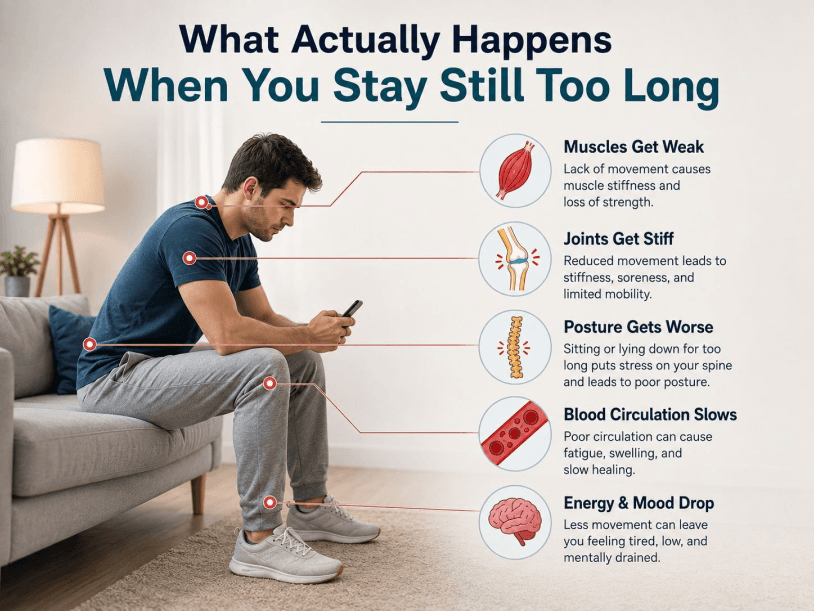
Leave the body still too long and things go downhill quicker than you'd think. Muscle strength doesn't wait around either, it starts dropping within days. The fluid that keeps joints gliding smoothly thins out, your heart and lungs get a bit less efficient, and there's hospital research linking extended bed rest to higher insulin resistance and sluggish digestion. Patients who stay bedbound too long after surgery also tend to pick up complications like pneumonia along the way.
The opposite holds too, in a fairly satisfying way. Get some gentle movement into the joints and they stay lubricated instead of seizing up. Muscles keep more of what strength they had. And the nervous system, oddly enough, needs the practice just as much, it has to keep relearning that movement is okay, that nothing bad is going to happen.
None of this happens all at once in a clinic, though. A physiotherapist won't wait for the pain to disappear before starting movement. It usually begins small, just a little range of motion within a comfortable zone, then light resistance, and eventually movements that start to look like your actual daily life again. That's why rehab plans are built as a slow progression instead of one set of exercises you repeat forever.
What the Research Says
This isn't just something we believe because it sounds nice. There's real evidence behind it.
One review published in BJS Open found that every extra day of bed rest after surgery nearly tripled the risk of lung complications. Patients who started moving earlier tended to leave the hospital sooner and got their function back faster too. That's part of why Enhanced Recovery After Surgery, or ERAS, protocols now treat early movement as a standard part of post-surgical care in hospitals around the world.
🔗 BJS Open — Importance of early postoperative mobilization: comprehensive review
Chronic pain tells a similar story, even though it's a completely different situation. A Cochrane review that looked at almost 25,000 people with chronic low back pain found decent evidence that exercise therapy helps reduce pain and improve function compared to doing nothing or sticking to usual care. Even NICE, the UK's health guidance body, now steers people away from long bed rest and toward staying active instead.
Different problems, but the pattern keeps showing up. Guided movement tends to beat prolonged stillness.
Who Actually Benefits From This Approach
Most people picture this as an athlete thing, someone rehabbing a torn ligament before the next season. In practice, that's a small part of what we do. A lot of the people who come through our doors are recovering from routine surgery and just need help getting range of motion back gradually, and starting early enough is part of how physiotherapy can prevent surgery. Others have had back or joint pain for years, the kind that never fully goes away, and find that consistent, well-chosen movement wears the stiffness down over months rather than overnight. And then there's an older crowd, where the point isn't performance at all, it's staying steady on your feet and independent for as long as possible, which oddly enough tends to require moving more, not less, as the years go on.
Every person we see is a little different, but the underlying goal doesn't really change. We're just trying to get the body moving the way it's built to, at whatever pace makes sense for that particular person.
Guided Doesn't Mean “Figure It Out Yourself”
One thing worth being upfront about: movement-first isn't the same as telling someone to go exercise on their own and hope for the best. There's a real difference between random movement and movement that's actually been assessed and planned around your condition, your current pain, and where you are in the recovery process.
That guidance is really the difference between exercises that help and movement that quietly makes things worse. Every exercise in a good plan is there for a reason, not just to fill up a session.
The Vyana Approach
We're not interested in just getting you moving for the sake of it. What we're actually after is helping you move like yourself again, rebuild real strength, and trust your body the way you used to, and we're thinking about that a year down the line, not just this week. Everything we build is grounded in evidence, shaped around what's actually going on with you, and practical enough to fit into a normal week rather than an idealised one.