Can Physiotherapy Help You Avoid Knee Replacement Surgery?
By Dr. Sakshi Bhatia, Physiotherapist, Vyana Care

Somebody said the word surgery to you. Maybe it was your doctor. Maybe it was a friend who got tired of hearing you complain about your knee. Now you're wondering if that's really where this ends up. Most of the time, no. Physiotherapy is usually the first move. Not because it sounds gentler. Because the research actually backs it.
Here's what we'll get into: what exercise and a couple of changes can do for your knee, who tends to see good results, what doctors and the official guidelines actually say, and when surgery is genuinely the answer.
What Causes Knee Pain That Leads to Surgery Talk?
Usually it's knee osteoarthritis. It's a lot more common than people think. Around 595 million people worldwide have some form of osteoarthritis, and knee osteoarthritis by itself affects roughly 16 percent of adults over 15. Yes, it gets more common as you age. Plenty of younger people deal with sore, stiff knees too.
You might recognise some of these signs:
- An ache by the third or fourth stair, worse by the top
- Needing to grab the table or armrest just to stand up
- Morning stiffness that eases once you get moving
- A weak or wobbly feeling, or the knee "giving way"
- Less range of motion when bending or straightening the leg
Why Do Knees Wear Out in the First Place?
Your knees do a lot of work you never think about. Every step you take, every stair, every time you get up off the sofa, that joint is carrying weight. Cartilage cushions it. Over the years it wears thin. That's what osteoarthritis really is, nothing more mysterious than that.
Pain doesn't mean the joint is done for. A lot of the time the real problem is muscles, mostly the quads and hamstrings. When they're weak, the knee has to pick up the slack. It ends up doing work it wasn't built for. Get those muscles strong again and the knee usually calms down a lot.
Why Rest Alone Rarely Fixes It
A tablet a day. A heat pack in the evening. Maybe you sit out a day if it's really sore. None of this is wrong to do. It just doesn't get near the problem. Your muscles are still weak. You're still walking the same way. So once the tablet wears off, the pain is back where it started.
Fixing it for real takes more than that. You need your strength back, and you need to move so your knee can handle a normal day without acting up.
“We do not stop exercising because we grow old, we grow old because we stop exercising.”
How Physiotherapy Helps the Knee
Forget the printed sheet of stretches you get handed on the way out the door. Real knee pain physiotherapy is structured and based on evidence. It comes down to a few basic things.
Building strength around the joint matters most. Strong hips and thighs hold the knee steady from the outside. When those muscles do their job, they soak up force that would otherwise go straight into the joint. That's really the point of most knee arthritis plans that don't involve surgery.
Restoring movement through guided exercise comes next. Physiotherapy leans on movement now, not just passive treatment. Manual therapy still has a place where it can loosen a stiff knee. Heat packs and ultrasound feel nice for a while, but they don't build strength and they don't fix how you move.
Correcting how you walk is the last piece. Sometimes the knee isn't really the problem, your gait is. Working on that spreads weight out evenly instead of piling it all on one side, and the same balance and gait work we use for fall prevention applies here. This ends up mattering as much as the exercises do.
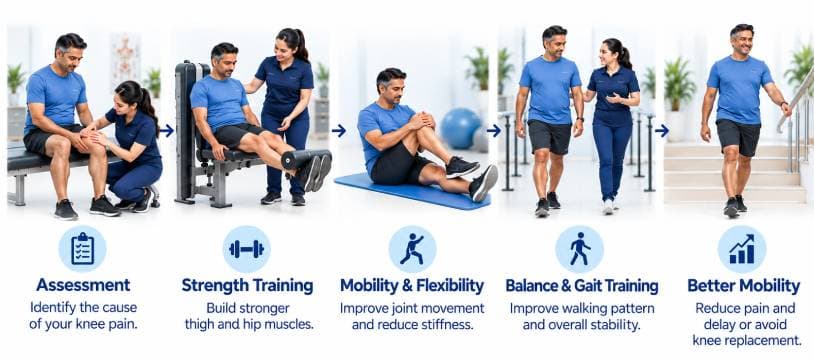
A good plan starts with an assessment: your pain, your mobility, your strength, and what your day actually looks like. Seeing a knee specialist beats copying exercises off a website, mainly because a specialist builds the plan for your knee, not for a reader.
Signs You May Benefit From Physiotherapy
Not sure if it's worth booking an assessment? Watch for:
- Pain while walking, on uneven ground or over longer distances
- Stairs feeling harder than they used to, going up or down
- Morning stiffness that loosens once you're moving
- A weak, wobbly feeling, or the knee "giving way"
- Reduced range of motion when bending or straightening the leg
- Pain that flares up after sitting for a while
If a couple of these sound like you, go get checked. It won't cost much and one visit tells you a lot.
Quick Reference: Is Physiotherapy Right for You First?
| Symptom | Physiotherapy First? |
|---|---|
| Mild to moderate knee osteoarthritis | Yes |
| Knee muscle imbalance | Yes |
| Post-injury stiffness (non-severe) | Yes |
| Bone-on-bone arthritis | Depends on severity |
| Visible deformity or locked knee | Orthopedic evaluation first |
What Does the Research Actually Say?
Anyone can tell you physiotherapy helps. Knowing why is more useful, because then you actually know what you're working toward.
Stronger muscles take pressure off cartilage that's already worn thin. That part makes sense on its own. Your walk is the other piece to fix. Walk unevenly for long enough and one side of the joint takes more punishment than the other. Fix the walk and the load spreads out properly again. Stairs stop being something you dread.
One thing to know before you start: exercise can feel worse before it feels better. NICE actually says this too. It doesn't mean anything's wrong. Most people who push through that rough patch see real improvement afterward, in pain and in daily life.
NICE's guideline on this, NICE: Osteoarthritis in over 16s — diagnosis and management (NG226), doesn't leave room for doubt. Strengthening and general activity come first. Medication supports that, it doesn't replace it. OARSI's international guidelines say the same thing: exercise and education first, medication and surgery later.
In practice, people who stick with a program for a month usually feel pain start to ease around six to twelve weeks in. Everyday movement gets better after that. A lot of people end up delaying surgery by years, not months.
That's basically why doctors like to see a trial run of three to six months of physiotherapy before surgery comes up as an option.
Who Benefits Most From Physiotherapy for Knee Pain
Not every knee responds the same way. Some bounce back fast with the right exercises. Others take a lot longer no matter how consistent you are. Knowing where you fall helps you know what to expect. Here's the short version:
| Condition Stage | Physiotherapy Effectiveness | Likely Outcome |
|---|---|---|
| Mild to moderate osteoarthritis | High | Pain relief, improved mobility, surgery often delayed |
| Muscle weakness related knee pain | Very high | Strengthening usually resolves symptoms |
| Post-injury stiffness (non-severe) | High | Near-full recovery with therapy |
| Severe bone-on-bone arthritis | Low to moderate | May reduce pain but surgery often still needed |
| Complete cartilage loss with deformity | Low | Surgery typically recommended |
Timing matters a lot. Start early, close to when the pain shows up, and your chances of avoiding or delaying surgery go up quite a bit.
What a Typical Physiotherapy Journey Looks Like
No two plans look exactly the same. Most knee osteoarthritis programs follow roughly the same path.
It starts with an assessment, figuring out what's causing the pain instead of guessing at it. Then comes the actual work: weeks of strengthening and mobility drills, managing pain as you go. After that it shifts into maintenance. People skip this part more than they should. It's what keeps a knee doing well for years, not just for the length of a program.
Stay with all three stages and you usually keep your results. Can't make it to a clinic regularly? Plenty of people keep going through guided online physiotherapy. Younger patients recovering from an injury rather than arthritis usually go through something similar under sports injury rehabilitation.
What Recovery Actually Feels Like
It's slow. That's normal, even when it feels like nothing is happening. The first small wins look like getting up from a chair without thinking about it, or taking the stairs without dreading them, or finishing a walk without paying for it that night. Small stuff, but it adds up. It means your knee is trusting itself again, not just hurting a little less for a moment.
Judge your progress by what you can do, not by whether every last bit of pain is gone.
Lifestyle Factors That Support Physiotherapy Outcomes
Physiotherapy on its own helps a lot. A few habits on top of that help more.
Weight is one of them. You don't need to lose a huge amount, even a small drop makes a real difference to the pressure going through your knee with each step. Staying active matters too, just pick the right kind. Swimming, cycling, walking on even ground, all of that keeps the joint moving without wearing it down further. Pushing through a run on a sore knee is a different story altogether.
Shoes matter more than most people realise. Decent support can change the alignment all the way up your leg. On the other hand, sitting for long stretches or squatting deep and often quietly adds pressure over time, worth thinking about if that's part of your routine.
Out of everything, the home exercise plan probably matters most. Skip it half the time and progress stalls. Stick with it. That's usually where the real change happens.
When Should You See an Orthopedic Specialist?
Physiotherapy works for most people, but it isn't always the best first step. Some issues need a doctor first, not a physiotherapist:
- Visible or major change in the shape of the knee
- Can't put any weight on the leg at all
- Knee feels stuck and won't bend or straighten
- Sudden swelling after an injury
- Fever with knee pain, which might mean an infection
If any of these match what you're going through, see a doctor. Physiotherapy isn't a replacement for that kind of care.
When Surgery Might Still Be Needed
Physiotherapy doesn't solve every problem. Major changes in the knee, bones rubbing together, real loss of cartilage, sometimes those issues are too big for exercise alone to fix. In those cases physiotherapy still helps. It strengthens the area before surgery and helps you recover faster after the operation. We've written more broadly on when physiotherapy can prevent surgery altogether if you want the bigger picture.
Think of physiotherapy as the step before, not something that fights against surgery. It's how you and your doctor figure out what the knee really needs before making decisions.
The Vyana Approach
At Vyana Physiotherapy we're not looking for a fix that stops the pain for a day and calls it done. We focus on building strength, improving the way you move, and helping you avoid or put off surgery when that's truly possible. Our care is based on evidence, plans made for you, and advice that fits into your daily life.
Thinking about whether physiotherapy's the right place to start? Vyana Physiotherapy offers a full assessment and builds a plan around what your knee actually needs, not something off the shelf.