
How Long Does Physiotherapy Take to Work?
By Dr. Sakshi Bhatia, Physiotherapist, Vyana Care

We hear this question almost every time someone comes in for their first visit. It's a fair thing to ask. Most people start feeling a bit different by session 2, maybe session 6 at the latest. But getting all the way back to normal takes more time. How much more depends on the injury, how bad it was, and if you actually keep up with the plan at home.
Short answer, most people notice something within 2 to 6 sessions. That's usually the first couple of weeks. After that it's harder to say. A pulled muscle can be fine in a few weeks. Surgery, or pain you've had for a year, that's usually a few months.
What Affects How Quickly Physiotherapy Works
There's no set number of weeks that works for everyone. Two people can come in with the same injury, do the same exercises, put in the same effort, and still heal at different speeds. That's just how the body works. A sprained ankle heals faster than a slipped disc. A new injury usually heals faster than an old one. And weirdly, an old injury that's flared up again can take even longer to calm down than it did the first time.
There's also stuff that has nothing to do with the injury itself. If you have diabetes, healing slows down. Same with arthritis. Smokers usually take longer to recover too. Extra weight puts more pressure on joints that are already trying to heal. Poor sleep and stress slow things down as well, more than most people think. But the biggest thing that decides how fast you heal is you. Doing your exercises, and doing them properly, matters more than anything else on this list. That's why a good physio gives you a plan made for your case, not a copy paste sheet. Keep up with your home exercises and you'll get there faster. Simple as that.
Typical Physiotherapy Recovery Timelines
A basic strain or sprain heals the fastest. You might feel a change in a week, and most people are close to back to normal in 2 to 6 weeks. Surgery takes longer. First signs of progress usually show up around 2 to 4 weeks in, but getting your full strength and movement back can take 6 weeks, or it can take 6 months. Depends on the surgery, and depends on you.
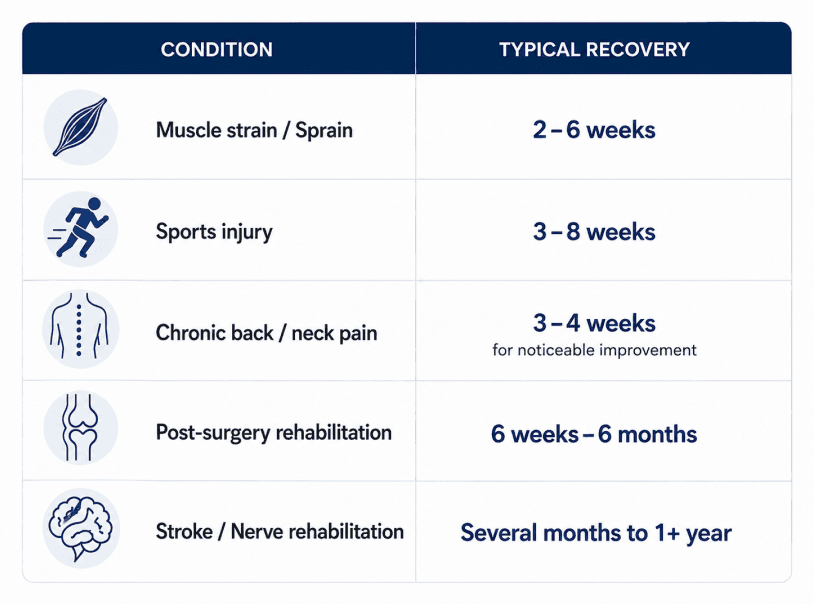
Chronic back or neck pain is somewhere in the middle. It usually takes 3 to 4 weeks before you feel a real change, and it keeps getting better after that. Sports injuries are similar, early improvement around 2 to 3 weeks, full recovery somewhere between 3 and 8 weeks. Nerve injuries and stroke recovery take the longest. Sometimes months, sometimes over a year. These are just rough numbers though, not promises. Once a physio has actually seen your case, they can tell you a lot more. Got a sports injury or just had surgery? Check our Sports Injury Rehabilitation and Post-Operative Rehabilitation pages.
Why Some People Feel Better After Just One Session
That looser feeling after your first session is real. It's not just in your head. Manual therapy loosens up tight muscles fast, and gentle movement plus hands on treatment can calm down pain signals for a while. But that doesn't mean you're fixed. Muscles, tendons, and ligaments still need time to repair, even after the pain eases off. Early relief is a good sign. It's just not the finish line.
Why Recovery Sometimes Feels Slow
Some weeks it feels like nothing is happening. That's normal. It helps to know that ahead of time so it doesn't mess with your head. A lot of healing happens quietly, you just can't see it, and strength comes back slowly, not all at once. Nerves take longer to heal than muscles do, so if nerves are involved, don't panic if it's slower than you'd like.
Pain also just changes day to day, whether anything underneath has actually changed or not. One bad day doesn't mean you're going backwards. Recovery is never a straight line. What actually helps is sticking with the plan, even on the days it feels pointless.
Signs Your Physiotherapy Is Working
It helps to know what progress actually looks like. Pain that fades a little at a time, even before it's fully gone, is usually the first thing people notice. Less stiffness in the morning is another one. So is being able to do normal stuff, bend down, carry groceries, reach for something, without it turning into a big deal. Sleep usually gets better too, since there's less pain waking you up. Your confidence during exercises tends to grow a bit each week as well.
Some people need less pain medication as they improve, though that's something to talk to your doctor about, not something to change yourself. If none of this is happening after a good few sessions, say so. Tell your physio. Most of the time it just means the plan needs a tweak. It doesn't mean physiotherapy isn't working.
What Can Help Speed Up Recovery
None of this is complicated. Don't skip sessions, and don't let them get too spread out. Do your home exercises the way you were shown, not the half remembered version from last week. Rest matters more than people think, so let the injury settle instead of pushing through pain to prove a point. Don't rush back into full activity too soon either. That's how people undo weeks of progress in one weekend.
The Vyana Approach
So how long does physiotherapy take? For most people, something starts to change within 2 to 6 sessions. Full recovery is harder to predict. Could be weeks, could be months. Depends on what you're dealing with, and how much effort goes in outside the clinic.
Healing is rarely a straight line. There will be slow weeks. Show up anyway and let your physio set the pace, don't try to rush it yourself. If you're not sure what your timeline looks like, a proper assessment will tell you more than anything online can. That's the idea behind Vyana Physiotherapy, a plan built around you, not a generic sheet everyone gets.