
Rotator Cuff Tear or Frozen Shoulder? How to Tell the Difference
By Dr. Asma Multani, Physiotherapist, Vyana Care

While reaching for the seatbelt makes you flinch suddenly. Washing your hair sends a jolt through your arm. Or maybe you just rolled over last night and it woke you up cold. Shoulder pain has a way of showing up at the worst moments, and most people just think of it all as "shoulder pain" without giving it a second thought. Truth is, a rotator cuff tear and a frozen shoulder are not the same problem. They just happen to look alike when things first go wrong.
There's a simple way to start figuring out which one you're dealing with. Just notice what your shoulder is actually doing. Does one movement always trigger it? Does it get worse the second you lie down? Small things like this actually matter a lot, because treating the wrong issue can leave you worse off, not better.
Rotator Cuff Tear, Explained Simply
The rotator cuff is made up of four small muscles and tendons. Imagine them like ropes holding your arm bone inside its socket, which lets you lift, twist, and reach out. A tear just means one of those tendons has ripped somewhere. Sometimes it's a small partial fray. Sometimes it goes all the way through.
There are basically two roads that lead here. One is sudden, a fall, an awkward jerk, or lifting something your shoulder simply wasn't ready for. The other one is slower, no dramatic moment at all, just years of overhead work like painting, swimming, or construction wearing the tendon down bit by bit.
What does it feel like day to day? Mostly a sharp pain when reaching overhead or behind your back. Weakness is the part people notice most though. You go for a plate on a high shelf, and your arm just gives out halfway there, like it forgot how to carry its own weight. AAOS OrthoInfo — Rotator Cuff Tears lays out the same pattern of pain, weakness, and gradual tendon wear in more clinical detail.
Frozen Shoulder, Explained Simply
Frozen shoulder is a whole different story. The medical name for it is adhesive capsulitis. All that means is the tissue capsule wrapped around your shoulder joint has gone thick, inflamed, and tight. Bands of scar tissue start forming inside it too, leaving barely any room for the joint to move. Most of the time, there's no clear injury behind it at all. It just quietly creeps in.
It's most common in people between their 40s and 60s. If you have diabetes or a thyroid condition, or your arm was kept still for a long stretch after surgery or an illness, your risk goes up quite a bit.
It usually feels like a dull, deep ache spread through the whole shoulder, with stiffness that just refuses to let go. There is one simple test that really tells the two conditions apart. Try to lift your arm yourself, and if you can't, ask someone else to gently lift it for you instead. With a torn rotator cuff, your arm usually moves fine when someone else lifts it, since the joint itself is not stuck, only your ability to move it on your own is affected. With frozen shoulder, the arm stays stuck either way. It does not matter who tries to move it or how relaxed you are, the joint itself has lost its range of motion.
Quick Comparison
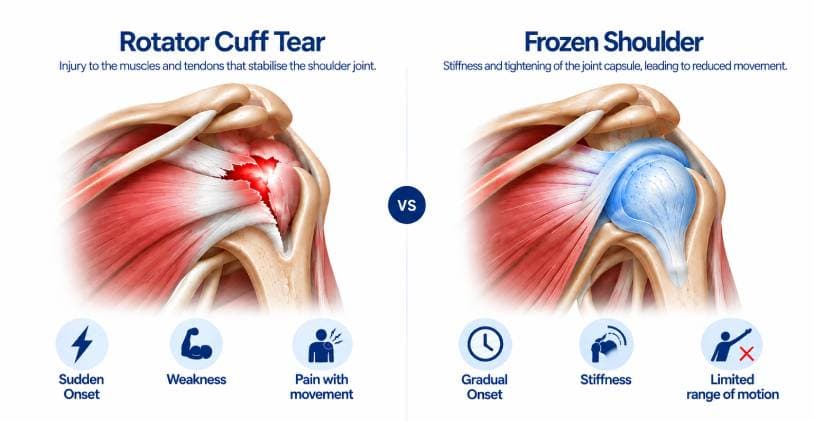
| Feature | Rotator Cuff Tear | Frozen Shoulder |
|---|---|---|
| How it starts | Sudden, often a fall or heavy lift | Slow, builds over weeks or months |
| Main feeling | Sharp pain, noticeable weakness | Dull ache, heavy stiffness |
| Movement with help | Hard alone, easier with assistance | Stuck no matter what |
| Arm strength | Weak when lifting | Mostly normal, just stiff |
| Common age | Any age, more likely past 40 | Usually 40 to 60 |
| Common triggers | Sports injuries, falls, overhead work | Diabetes, thyroid problems, long immobility |
How Symptoms Change Over Time
With a rotator cuff tear, the pain usually starts right around the time of injury. If it's ignored for too long, the sharp jolt can settle into a dull, constant ache, and the arm keeps losing strength as the muscles around it weaken from being used less.
Frozen shoulder takes a slower path. It generally runs through three separate stages, which is a big part of why frozen shoulder takes so long to heal.
Freezing stage, around 2 to 9 months: The pain builds slowly, tends to be worse at night, and movement gets tougher in nearly every direction.
Frozen stage, around 4 to 12 months: Pain can actually calm down a little here, but stiffness ramps up hard. Even something simple like reaching into a back pocket starts feeling impossible.
Thawing stage, around 6 to 24 months: Movement slowly comes back, and things ease their way back toward normal.
Why Getting the Right Diagnosis Matters
Getting these two mixed up can honestly do more harm than good. Aggressive stretching works well for loosening a frozen shoulder, but doing the same thing to a torn rotator cuff can tear it even further. Complete rest might work well for a fresh tendon injury, though resting a frozen shoulder does the opposite of helping. It just lets the capsule tighten more.
A real checkup usually means movement tests, strength checks, and sometimes an ultrasound or MRI so a specialist can see exactly what's happening inside the joint. Now and then, someone actually has both conditions going on at once. That alone is a good reason to get it looked at properly instead of guessing based on symptoms alone.
“Diagnosis is the first step to successful treatment.”
What Recovery Looks Like
Recovery is slow either way.
Rotator cuff tears usually call for strengthening the muscles around the tear, adjusting how you move through the day, and managing pain along the way. If the tear is severe, surgery to reattach the tendon is sometimes needed, with a slow rehab process after that, though it is worth knowing how often physiotherapy can prevent surgery in the first place.
Frozen shoulder is more about gentle, steady stretching to loosen up the tight capsule, plus pain management and physiotherapy exercises for shoulder mobility that slowly bring movement back.
Either way, having a proper, structured plan tends to work a lot better than just resting at home and hoping it fixes itself with time.
The Vyana Approach
A rotator cuff tear and a frozen shoulder can both leave your shoulder sore and hard to live with, but they start from opposite places, so the way they're treated has to look different too. Think about how the pain first showed up, whether it feels more like true weakness or plain stiffness, and which movements bring it on. Small details like these tell you a lot more than you'd expect. Still, nothing replaces an actual hands-on check by someone who knows what they're looking at. At Vyana Physiotherapy, we take that time properly, looking closely at how you move, working out what's really going on, and putting together a recovery plan built around your shoulder, not a routine copied from somebody else's case.