
Why Frozen Shoulder Takes So Long to Heal: Here's What Actually Helps
By Dr. Asma Multani, Physiotherapist, Vyana Care

What Is Frozen Shoulder, Really?
Try this. Reach behind your back to grab a zipper. Or lift your arm up for something on a shelf. Sharp pain? A stuck feeling? That might be frozen shoulder. Doctors call it adhesive capsulitis, but let's skip the fancy name. Your shoulder sits inside a soft tissue capsule. That capsule is normally loose. Stretchy too. That's why your arm moves so freely most days. But once it swells up and starts to thicken, everything tightens fast. Basic movements suddenly feel stuck. The NHS guide to frozen shoulder describes the same pattern of pain and stiffness building up over months.
It hits people between forty and sixty the most. Women get it more than men. Diabetes raises your risk. So does a thyroid problem. Keeping your shoulder still for weeks after surgery or an injury does too. And here's the thing, it doesn't take much. Even a small injury, one that just keeps you from moving your arm properly for a bit, can set the whole thing off.
Why Does It Take So Long to Heal?
This part surprises almost everyone. Frozen shoulder doesn't heal in a straight line. Not like a sprained ankle. It moves through three stages, and each one runs at its own speed.
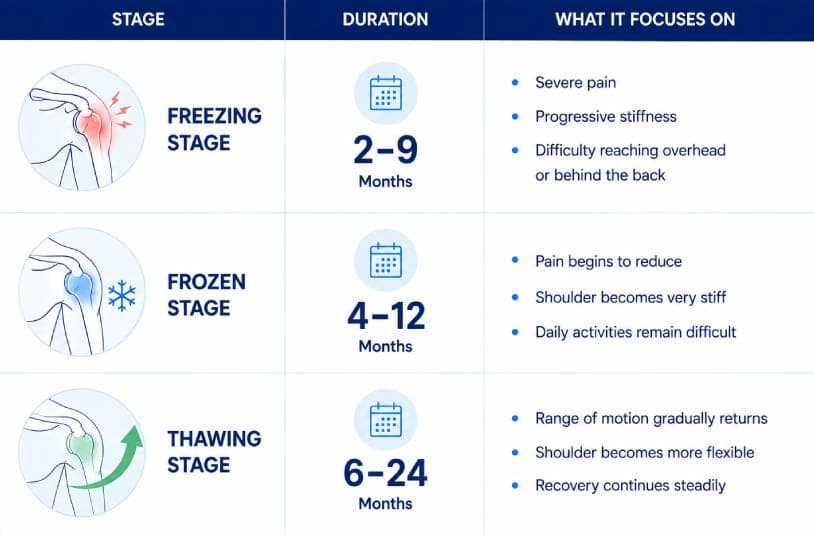
Here's how to think about it. First your body calms down the swelling. Then it slowly reshapes the tissue that thickened up. Only after that does your movement start coming back. Try to rush any part of it, especially during the frozen stage, and you'll probably end up worse off. That's the real reason people talk about frozen shoulder recovery time in months, not weeks. Two people can have the exact same diagnosis and still heal at totally different speeds. It just depends on how their body handles it. If timelines are what's on your mind, here's how long physiotherapy usually takes to work.
One more thing worth knowing. Your shoulder is one of the most mobile joints in your body. It needs a lot of soft tissue working together at once. So even a little tightness in that capsule throws off a lot of movement. Getting that coordination back takes real time. A few physiotherapy sessions won't undo months of stiffness in one shot, no matter how badly you want it to.
“Each patient carries his own doctor inside him. We are at our best when we give the doctor who resides within each patient a chance to go to work.”
What Actually Helps During Each Stage
Here's the honest bit. You can't really speed up frozen shoulder by much. Not with anything currently available. But good care makes the whole thing easier to live with. It also helps you keep as much movement as you can while your body slowly does its job.
A few things genuinely help:
- Physiotherapy exercises picked for wherever you are right now, not random stretches from a video
- Gentle hands on mobilization from someone trained to do it
- Basic pain relief, heat, small tweaks to daily activity, or medication if your doctor suggests it. If you're unsure which to reach for, here's when ice helps and when heat helps.
Frozen shoulder physiotherapy matters here because a trained physiotherapist can actually tell how much your shoulder can handle at any given moment. Too little movement, stiffness gets worse. Too much, you risk a flare up. That line shifts almost every week as you move through the stages. Which is exactly why sorting this out alone gets frustrating fast.
Home Care vs Professional Physiotherapy
A lot of people start with home stretches and rest alone. Some of that genuinely helps. But it works best as backup support next to real physiotherapy, not as a stand in for it.
| Approach | What It Offers | Limitation |
|---|---|---|
| Home stretching and heat packs | Mild pain relief, keeps a little mobility | Doesn't really loosen the tight capsule |
| Rest and avoiding activity | Cuts pain in the short term | Can let stiffness build up more over time |
| Physiotherapy led treatment | A plan built around your actual stage | Needs regular sessions and some patience |
That's basically why shoulder pain relief from self care alone tends to stall out after a while. A proper physiotherapy plan usually keeps showing progress instead. Nothing wrong with home care on its own. It just works better as part of something bigger.
Simple Habits That Support Healing
Along with actual treatment, a few small daily habits help. None of them strain the joint.
- Move your shoulder gently within a pain free range each day. Don't avoid movement altogether.
- Warm it up a bit before stretching so the muscles around it loosen.
- Watch your posture while sitting or working. Slouching adds more pressure on the shoulder than most people think, and posture isn't really about sitting straight.
None of this replaces real treatment. What it does is give your body a better shot at healing. Showing up regularly beats pushing hard once in a while. Small, steady effort protects your movement better than one hard stretching session every few weeks.
When Should You See a Physiotherapist?
If your shoulder has been stiff for more than a few weeks, get it looked at. Same goes if simple things, getting dressed, reaching overhead, sleeping on that side, have turned into a struggle. Getting help early, during the freezing stage, usually makes the rest of the journey a lot easier.
A physiotherapist can also check if it's really frozen shoulder, or something else like a rotator cuff issue. The two can feel oddly similar but need completely different treatment. Getting the right diagnosis early saves a lot of time later on. Treating the wrong problem quietly stalls your progress for months, sometimes without you even noticing.
The Vyana Approach
At Vyana Physiotherapy, we don't treat frozen shoulder like a one size fits all problem. It isn't one. Every assessment starts with figuring out which stage your shoulder is actually in. Freezing, frozen, and thawing each need their own mix of rest, mobilization, and strengthening.
From there, we build a frozen shoulder treatment plan around that stage. We keep adjusting the mobilization and exercises as your shoulder improves. The goal each session stays simple. Bring your pain down without triggering a flare up. Keep working, bit by bit, toward getting back the movement frozen shoulder took from you.
If your shoulder has been stiff or sore for a while, come in for a proper evaluation at Vyana Physiotherapy. We'll help you figure out exactly where things stand and what to do next.