Patellofemoral Pain Syndrome: Causes, Symptoms & Treatment for Front Knee Pain
By Dr. Asma Multani, Physiotherapist, Vyana Care
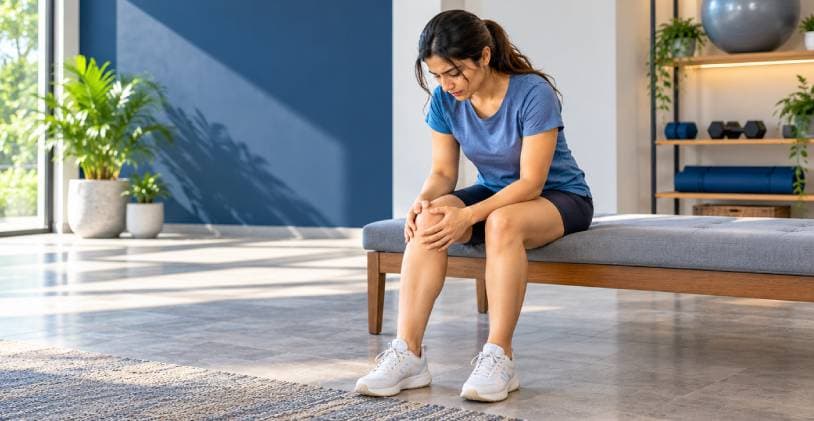
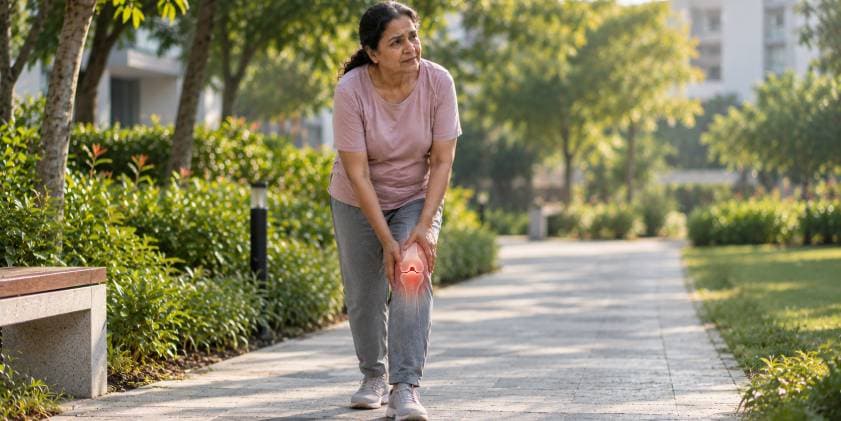
You get up from your chair after a day at work. You take one step. There it is again. That sharp ache at the front of your knee, just under the kneecap. You walk a bit. It fades. By evening you've forgotten about it. Then the next morning you go down the stairs and you feel it again.
Sound familiar?
We hear this story every week at our clinic. Most of the time the person has been living with it for months before coming in. When we ask why they waited, the answers are usually the same.
"I thought it was my shoes."
"I thought I just overdid it at the gym."
"I thought this is what happens after 35."
Sometimes that's true. But when the pain keeps coming back in the same spot after the same kind of activity, it's usually telling you something.
In a lot of these cases the reason is Patellofemoral Pain Syndrome. It's a name we know well. It's actually one of the most common reasons for pain at the front of the knee. Most people have just never heard of it.
So let's talk about it.
What Causes Patellofemoral Pain Syndrome
Your kneecap is a bone that sits at the front of your knee. Doctors call it the patella. Behind it is the end of your thigh bone, and there's a small groove there. When you bend and straighten your leg, the kneecap slides up and down in that groove.
When everything is working well you don't even notice this. The muscles around your thigh and knee hold the kneecap in its place, pulling a bit from each side so it stays in the middle.
Now imagine one side pulls harder than the other.
Let's say the muscle on the outer side of your thigh is tight and the one on the inner side is a bit weak. Every time you bend your knee, the kneecap gets pulled slightly to the outside. Not a lot. You wouldn't be able to see it in the mirror.
You bend your knees all day. Getting out of bed. Sitting down for breakfast. Climbing into the car. Going up to the office. Squatting to pick something up. Over weeks and months, that small pull puts pressure on one part of the joint behind the kneecap. That area gets irritated. It starts to hurt.
Here's the part most people don't expect. The knee is often not where the problem starts. It's where you feel it. The real cause is usually in the muscles around it, and sometimes in your hips or feet.
Not Just a Runner's Problem
You may have heard someone call this "runner's knee." It's a common name, but honestly it gives the wrong idea. People think, "I don't run, so it can't be that."
We see it all the time in people who never run.
- College students who sit in lectures all day.
- IT professionals who don't leave their desk for hours.
- Mothers who go up and down the stairs twenty times a day with laundry or kids.
- Older people who like their evening walk.
- Teenagers who've grown an inch in one year.
It also shows up a lot in people who suddenly start exercising after a gap. New Year's resolution, gym membership, too much too soon. Then the knee starts complaining.
So if your knee hurts at the front and you're not a sportsperson, don't rule this out.
Why It Gets Worse After Sitting
This one confuses a lot of people. "Why does my knee hurt after resting? Shouldn't rest make it better?"
Here's what happens. When you sit with your knees bent for a long time, the kneecap stays pressed against the thigh bone the whole time. The tissue around it gets stiff. Then you stand up quickly. Your leg straightens before that stiff tissue has had a chance to loosen. That's the moment you feel the pain.
Some people call it the "movie sign." Sit through a three-hour film. Try standing up at the end. If you have this problem, you'll know.
Stairs work in a similar way. Most people tell us going down is worse than going up. That's because when you step down, your thigh muscles have to control your body weight as it lowers. A lot of that load goes through the kneecap. Sitting on the floor, squatting, kneeling for prayers, getting up from the sofa... all of these can set it off too.
Signs Worth Watching For
So how do you know if it might be this? Look out for these:
- An ache around or behind the kneecap when you're active
- Pain when you stand up after sitting for a long time, which eases once you walk a bit
- A grinding or clicking sound when you bend or straighten the knee
- More pain while going down stairs, squatting or kneeling
- Your knee feels a little weak or unsure on certain movements
Don't panic if you tick one or two of these. But don't ignore them either.
The tricky thing is, none of this feels serious at the start. So people wait. And while they wait, they slowly start moving differently without realising it. They take the lift instead of the stairs. They stop going to the gym. They lean more on the other leg. After a month the hip, lower back or the other knee starts hurting too. Now it's more of a problem than it needed to be.
What Usually Contributes
It's almost never one thing. Usually it's a mix of issues that build up quietly. Here are the ones we see often:
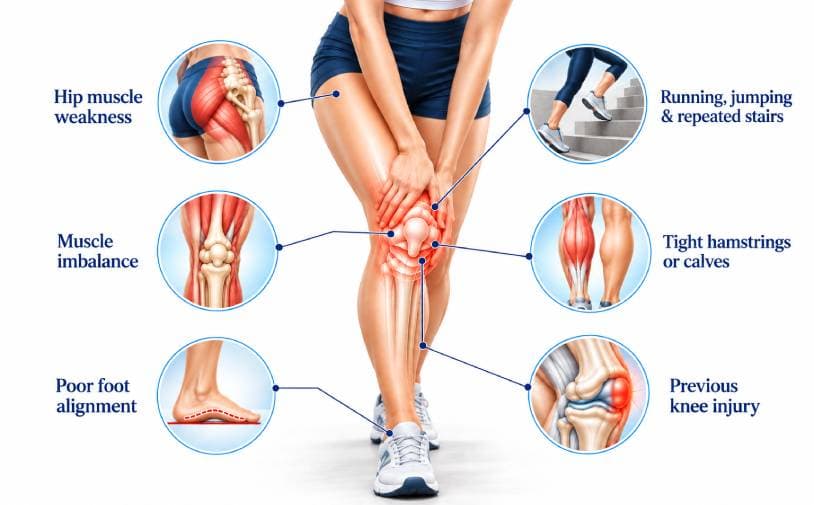
| What Contributes | How It Affects the Knee |
|---|---|
| Weak inner thigh muscles | The kneecap slowly drifts to the outside |
| Flat feet or poor foot position | Changes how pressure travels up the leg |
| Running, jumping or a lot of stairs | Puts repeated stress on the kneecap |
| Tight hamstrings or calves | Changes how the kneecap moves in its groove |
| Weak hip muscles | Less control over how the leg lines up when you walk |
| An old knee injury that didn't fully heal | Leaves behind bad movement habits |
The hip one surprises people the most. They come in for knee pain. We start testing their hip strength. They look at us like, "Why are you checking my hip?"
Here's why. If the muscles on the side of your hip are weak, your thigh tends to roll inward when you walk or climb stairs. When the thigh rolls in, the kneecap sits at the wrong angle. More pressure goes onto one side. Over time, that hurts.
Feet play a part too. If your arches drop when you stand, your lower leg turns inward. The knee goes along with it.
The good part is that once we know which of these are behind your pain, the plan becomes very clear. No guessing. The Cleveland Clinic also lists it as one of the common knee problems in active people, and that's exactly what we see in our day-to-day practice too.
How Patellofemoral Pain Syndrome Is Diagnosed
Most people expect to be sent for an MRI. In most cases you don't need one.
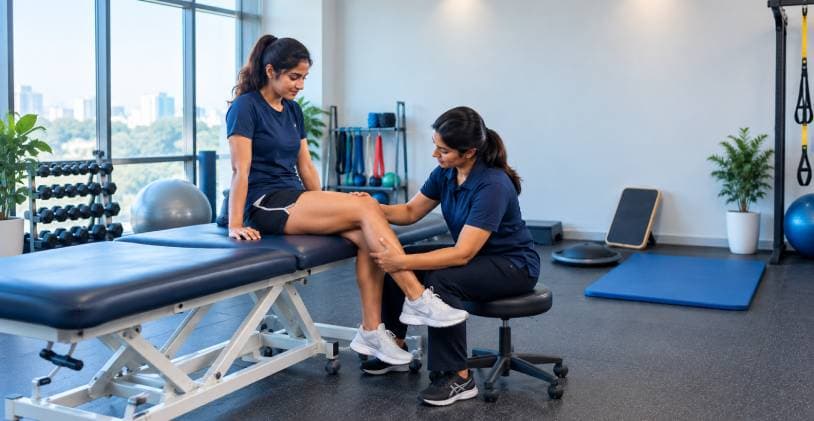
When you come in, your physiotherapist will look at how your kneecap moves. They'll check the strength of your hips and thighs. They'll ask you to walk, do a squat and step down from a step while they watch. They'll also ask about your routine. What kind of work you do, how long you sit, what you do for exercise, what makes the pain worse.
That usually tells us most of what we need to know.
Sometimes an X-ray or scan is useful, mainly to rule out something like a ligament tear or knee arthritis. But a scan is just a photo. It can't show us how your knee behaves when you climb stairs or get out of a chair. Watching you move tells us more.
What Actually Helps
First, the news everyone wants to hear. Surgery is rarely needed for this. Most people get much better with physiotherapy for knee pain.
So what does that actually look like?
Strengthening
A big part of it is strengthening. Mostly the hips, the thighs and the core. When these muscles do their job properly, the kneecap stays where it should. The pressure spreads out evenly. We start with gentle exercises, nothing that hurts. Then we slowly make them harder as your knee gets stronger. Most of these can be done at home with no equipment at all.
Hands-On Treatment
Then there's hands-on treatment. Your physiotherapist will work on tight muscles and stiff tissue around your knee and hip. This helps a lot with the pain in the first few weeks and makes the exercises easier to do.
Fixing How You Move
The third part people often skip, but it matters a lot. Fixing how you move. How you sit down. How you get up. How you go down the stairs. Something as simple as keeping your knee in line with your toes, or using your hips more when stepping down, can take a lot of load off the kneecap.
Easing Off Activities
You might also need to ease off activities for a while. Not stop completely, just cut back. If running 5 km hurts, maybe it's 2 km for a week. Then we build back up. In some cases taping, insoles or a change of shoes can also help.
“Exercise is one of the most important things you can do for knee pain.”
Not sure if ice or heat is better for you? Our article on ice versus heat explains when each one actually helps.
Rest It or See Someone?
Not every knee ache needs a clinic visit. Here's a rough way to decide:
| Your Situation | What To Do |
|---|---|
| Pain just started, no swelling | Rest a little, stretch gently, wear supportive shoes |
| Pain that lasts two or three weeks | See a physiotherapist |
| Pain that stops you from using stairs or exercising | Get it checked soon |
| No improvement even after resting | Book a physiotherapy evaluation |
One more thing. If your knee is very swollen, locks up, gives way under you, or starts hurting after a fall or a twist, please don't wait. That could be something more serious, and it's best to get it looked at quickly.
Preventing It From Starting
If you're about to start treatment, it helps to know what kind of timeline to expect. Our guide on how long physiotherapy takes to work explains it in detail. Knee pain relief usually comes slowly and steadily. Not overnight, but it does come.
If your knees feel fine right now, a few small habits can help keep it that way.
- Warm up before you exercise. Five or ten minutes of easy walking and gentle movement makes a difference.
- If you have a desk job, get up every 30 to 45 minutes. Walk to get water. Stretch your legs. Your knees will thank you.
- Wear shoes that actually support your feet, especially if you're standing or walking for most of the day. Those flat, worn-out slippers don't count.
- Don't jump into a new workout or suddenly double your walking distance. Build up slowly.
- Try to do a few simple hip and thigh exercises a couple of times a week, even when nothing hurts.
None of this is difficult. But most of us skip these things day after day. That's often how Patellofemoral Pain Syndrome sneaks up on people.
The Vyana Approach
At Vyana Physiotherapy we don't believe in handing someone a printout of ten exercises and saying "see you in a month." That doesn't work. Honestly, most people stop doing them after a week anyway.
Everyone's knee pain is a little different. It depends on your muscles, your job, your routine and habits you've had for years without noticing. So your treatment should be built around you.
We start by watching you move. Where is the kneecap drifting? Which muscles aren't pulling their weight? Are the hips or feet playing a part? Then we put together a plan that usually mixes strengthening, hands-on work and small changes to how you sit, walk and use stairs. We check in on your progress as we go and change things when needed.
We're not trying to make the pain disappear for one week. We want to sort out what's causing it, so it doesn't come back the moment life gets busy again.
If your knee has been bothering you for a while, get it checked. Trust us, it's much easier to fix now than after a year of putting it off.